


Maybe you’ve already bought the cameras — four, maybe six, with night vision and a companion app. Or maybe a break-in two streets over is what’s pushed you to install a system, and you’d rather get the positions right the first time than guess. Either way, what nobody tells you at the point of sale is where to place CCTV cameras so they actually cover your property, rather than just pointing at it.
That gap is more common than it sounds. WA Police crime data shows Perth’s metro area records well over 12,000 residential burglaries a year, most of them opportunistic rather than targeted — which means correct placement genuinely affects whether a property gets chosen at all, not just what gets recorded afterward. The single most frequent callout we get isn’t a broken camera — it’s a homeowner who installed a system themselves, or inherited one from a previous owner, and only discovered the blind spot after something happened inside it. A side gate was never covered. A driveway angle that catches the car but not the person walking up to it.
Picture the alternative: every gate genuinely covered, footage that actually shows a face rather than a shadow crossing the frame — a system that does what you bought it to do, not a rough approximation of it. That’s what correct placement, not more cameras or pricier hardware, actually gets you.
This guide gives you the specific camera placement, mounting heights, and spacing a Perth home needs — adjusted for WA’s climate, and the entry points local burglars actually use, not the generic advice written for a US-market home.
The 6 camera positions every Perth home should cover first
Before angles, heights, or hardware, get the positions right. These six cover the access points that matter on almost any standard Perth block:
- Front entry and driveway gate — covers vehicles arriving and is the most visible approach to your home.
- Side-access gates (both sides) — the position most homeowners’ plans miss, and the one Perth burglars target first.
- Rear yard or back fence line — covers the access point, neighbours, and street traffic can’t see.
- Garage entry — protects tools and vehicles, often the easiest door into the house itself.
- Front door and porch — captures parcel theft, visitors, and anyone testing the lock.
- Inside the front door or hallway — the only interior camera most homes need, confirming exactly who entered.
Brillare’s CCTV installation team, with a combined 50+ years of experience installing CCTV across Perth, has worked on hundreds of properties, and one pattern holds up suburb after suburb: in outer growth areas like Baldivis and Ellenbrook, side-access gates are consistently the first zone targeted — and the last thing most homeowners’ initial camera plans cover. A front door camera feels obvious. A side gate, tucked along a fence line, doesn’t — until it’s the one gap that mattered.
How high should outdoor CCTV cameras be mounted? (And why most homeowners get this wrong)
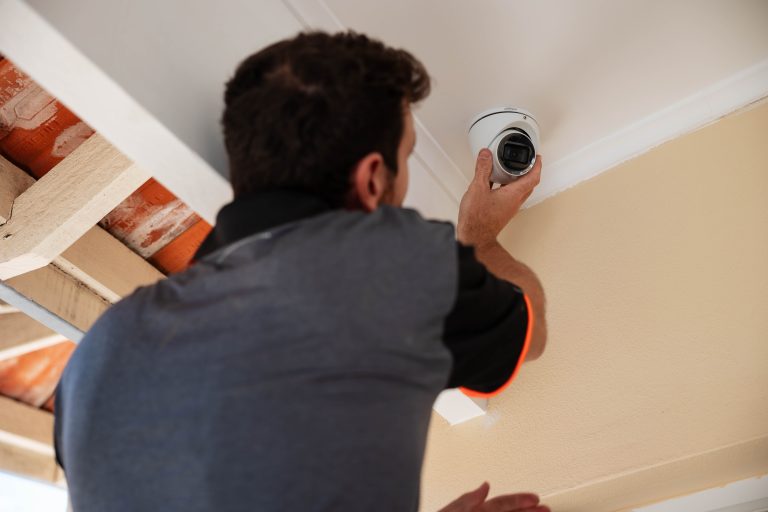
Most placement advice online is written for the US market, and gives camera mounting height in feet — commonly 8 to 10 feet. In metric, that’s roughly 2.4 to 3 metres, the range to work with for a standard Perth home: high enough that a camera can’t be reached and turned away by hand, low enough that it still captures a clear, identifiable view of a face rather than the top of someone’s head.
This is where most DIY installs go wrong in one of two directions. Mounted too low — under 2 metres — a camera is an easy target for anyone willing to reach up and redirect it. Mounted too high — above 3.5 metres, a common over-correction — the downward angle needed to see anything ends up capturing the crown of a head instead of a usable, identifiable face. Neither mistake shows up until the footage needs to prove something, which is exactly the wrong time to discover it.
The fix: angle the camera slightly downward from within the 2.4–3m band, aimed at the point someone would stand while opening a gate or door — not straight down at the ground beneath it.
Night vision deserves the same care. A camera mounted too close to a reflective surface — a light-coloured wall, a glass door, a pool fence — can wash out its own night footage with reflected infrared. Keeping cameras clear of anything directly reflective within a metre avoids it, and pairing outdoor cameras with dedicated security lighting gives clearer, more identifiable colour footage at night than infrared alone.
Coverage overlap: how gaps between camera fields of view expose your property
A single camera’s field of view (FOV) typically runs 90–110 degrees, depending on the lens. Cover six positions with six cameras aimed purely outward, and it’s easy to end up with narrow gaps where nothing is actually recorded — usually along fence lines or at property corners, wherever two cameras’ fields were assumed to meet but don’t quite.
Corner-mounted cameras solve most of this by design: a camera at a building corner naturally covers two directions at once, which is why the six-position list above leans on corner and gate-adjacent placements rather than flat mid-wall mounting. Where a true gap remains — a long side passage, for instance — stand at the edge of each camera’s expected field of view and confirm the neighbouring camera’s field already begins before it ends. Pair this with correctly configured PIR motion detection zones on each camera, so movement through the overlap itself reliably triggers a recording.
Perth-specific CCTV considerations: UV, heat, and summer dust
This is the section most placement guides skip entirely, because most of them aren’t written for this climate. Summers here regularly push past 40°C, with western and outer suburbs seeing extended runs above 45°C most years. That heat, combined with some of the highest UV exposure of any Australian capital, degrades camera housings and cable insulation not specifically rated for it — well before the camera’s own electronics would otherwise fail.
Two consequences follow. First, hardware rating matters more here than in a milder climate: look for an IP67 rating on any outdoor camera, confirming the housing is both dust-tight and rated for water exposure — genuinely useful in a state that swings between summer dust storms and short, heavy winter downpours. When we recommend Hikvision camera installations or Dahua camera installations for Perth conditions, it’s specifically because their outdoor-rated ranges meet this standard as a baseline. Second, cable routing deserves more thought than “shortest path to the router” — shaded conduit, rather than a cable run exposed along a north-facing wall for years, meaningfully extends its working life.
None of this shows up in a US-written placement guide, because none of it is a problem in the markets those guides are written for. It’s a genuinely Perth-specific consideration, not a generic add-on.
Indoor vs outdoor camera rules — different installation requirements for each
Outdoor cameras need weather rating; indoor cameras don’t, but they raise a different consideration — what the camera can see once it’s inside your home. An interior camera confirming who has entered through the front door is genuinely useful. One angled to capture more than that, particularly anything extending into a neighbouring property through a window, moves into legal territory this guide doesn’t cover — Brillare’s guide to CCTV privacy laws in Western Australia sets out where that line sits.
Practically, outdoor cameras handle perimeter and entry-point coverage; a single indoor camera near the main entry is usually sufficient to confirm who came through the door your outdoor cameras already flagged.
How many cameras does a home actually need?
For a standard suburban 4×2, the six positions above map neatly to five or six cameras — the front door and porch can often share a single wide-angle camera with the driveway view, depending on the block’s layout. A corner block typically needs one additional camera, since a corner position changes which side gate is genuinely the less visible one. A semi-rural property with a larger perimeter needs more cameras and longer cable runs, worth planning for from the outset rather than extending a system piecemeal later.
More cameras isn’t automatically better coverage — six well-placed cameras beat ten poorly overlapped ones, and extra units usually just add cost without closing a real gap. If cost is the deciding factor between five, six, or more, our guide to CCTV installation cost in Perth breaks down the numbers before you commit to a system size.
DIY camera positioning vs professional installation — where the difference shows
A DIY install and a professionally positioned one can use identical hardware and still perform very differently, because almost every mistake in this guide is a positioning mistake, not an equipment one: a mounting height guessed rather than measured, an overlap gap nobody checked, or privacy masking never considered for a camera that happens to catch a slice of the neighbour’s yard.
A professional site assessment catches these before the mounts go in, not after an incident reveals them — the height, angle, and overlap decisions above get made once, correctly, rather than adjusted twice after the fact. If you’d rather have that done the first time properly, Brillare’s residential CCTV installation service covers exactly this across the Perth metro area.
Frequently asked questions
Can my neighbour’s CCTV point at my house?
In general, yes — a neighbour can have cameras on their own property, including ones that incidentally capture a public street or your fence line. It becomes a legal issue if their camera deliberately captures a private area of your property, such as your backyard or through a window. The full detail — including what to do if a neighbour’s camera has crossed that line — is covered in Brillare’s guide to CCTV privacy laws in Western Australia.
Do I need council approval to install CCTV at my Perth home?
No, for a standard residential installation on your own property. The considerations that do apply are about what the camera captures, not where it’s mounted — see the privacy laws guide linked above for what that means in practice.
The bottom line
Knowing where to place CCTV cameras — six points, mounted at the correct height, with genuine overlap between them — closes the gaps most Perth homes’ first camera plan misses, particularly the side gate, the single most common blind spot we find on callouts across the metro area. Get that right, in hardware actually rated for a Perth summer, and the system does the two jobs it’s meant to do: record clearly if something happens, and visibly deter it from happening in the first place.
Not sure if your planned camera positions will give you full coverage? Brillare offers a free CCTV site assessment across Perth. Call 08 9415 0762, and we’ll confirm exactly where each camera should go before anything gets mounted.






 @brillareelectricians
 brillare_electricians
 brillare electricians
 brillare perth electrician
  @brillareelectricians