


Your neighbour has mentioned, not entirely pleasantly, that your camera seems to be pointed at their yard. Or you’ve just installed a system and want to know where the line sits before anyone raises it. Either way: what do CCTV privacy laws in Western Australia actually allow, and where does that allowance stop?
Most of what circulates online about this doesn’t actually apply here. National guides quote the Privacy Act 1988 (Commonwealth) — a law that, by its own terms, doesn’t cover a private individual’s home security camera at all. The law that actually governs a WA homeowner’s CCTV system is the Surveillance Devices Act 1998 (WA), and it’s more specific than most people expect.
This guide covers your own property, your neighbour’s, audio recording, signage, tenancy rights, and what to do if a dispute is already brewing — in plain English, from a team that configures CCTV systems to this exact standard every week across Perth.
Is it legal to install security cameras on your own property under WA privacy law?
Yes. In Western Australia, you can install security cameras on your own private property — entrances, driveways, garages, backyard areas — without needing council approval or anyone’s prior sign-off. The condition attached to that freedom is straightforward: the camera must be positioned to capture your own premises as its primary subject. Where exactly each camera should go to achieve that without creating blind spots is a separate, practical question covered later in this guide.
Can a neighbour have CCTV pointing at your property?
In Western Australia, a neighbour can have CCTV cameras pointed at their own property. The issue arises if their cameras capture areas where you have a reasonable expectation of privacy — such as your backyard or inside your home. Under the Surveillance Devices Act 1998 (WA), recording in a private place without consent may be an offence.
The test that actually gets applied isn’t whether a camera catches a sliver of your side fence — it’s whether the camera is, in substance, confined to the owner’s own property or deliberately angled into yours. This is the distinction drawn in the Act itself, not a Brillare interpretation of it: incidental capture of a public footpath or the street is generally fine, while a camera angled to capture your yard, windows, or driveway intentionally is not, regardless of which side of the boundary it’s mounted on.
Audio recording on home CCTV — what WA law actually says
The rule: recording a private conversation without everyone’s consent is illegal in Western Australia under the Surveillance Devices Act 1998. The exception most people expect — “but I’m one of the people talking” — doesn’t apply here. WA’s law requires consent from all parties to a conversation, not just the person recording, which is stricter than several other states.
Audio is the single biggest compliance risk on a home CCTV system, precisely because it’s the feature people think about least. If your cameras include a microphone and you haven’t specifically obtained consent from anyone who might be recorded in normal use — visitors, delivery drivers, a neighbour over the fence — the lowest-risk approach is to disable audio recording entirely. Video alone still delivers the deterrence and evidentiary value most homeowners actually want.
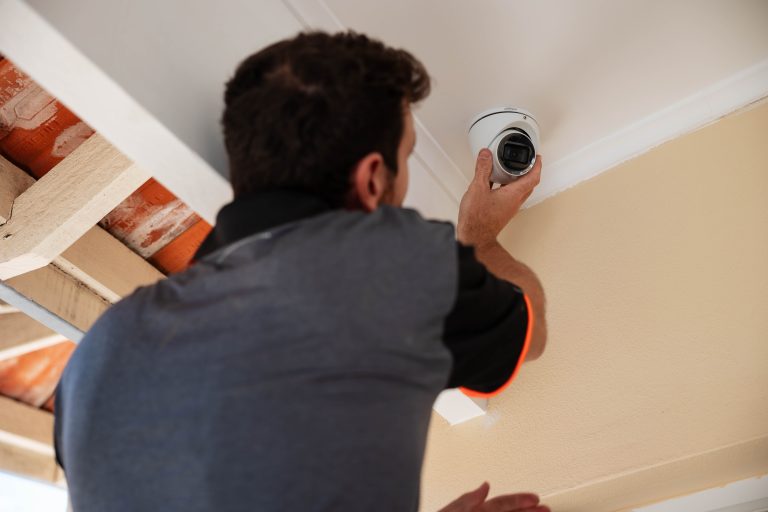
Brillare’s CCTV installation team configures a privacy mask — a digitally blacked-out zone within a camera’s field of view — on every job where the camera’s angle could reasonably capture a neighbouring property. It’s the practical fix for exactly the scenario this guide is about: a camera that needs to cover your own driveway or side gate but happens to sit close enough to a boundary that some overlap is otherwise unavoidable.
Do you need signage for home CCTV in Western Australia?
No. For a standard private residence in WA, there’s no legal requirement to display signage announcing CCTV is in operation — that obligation exists in some commercial and workplace settings, but not for a private home. That said, a visible sign is a low-cost way to reduce exactly the kind of dispute this guide exists to prevent: a neighbour who assumes the worst reacts very differently to one who’s already seen a sign and can ask about it directly.
Recording in shared or common areas — strata, driveways, footpaths
A camera on your own property that incidentally captures a shared driveway, a footpath, or the street is generally fine — the law treats this as incidental capture of a public area, not surveillance of a private one. Strata properties add a layer that freestanding homes don’t have to consider: an owners’ or strata company’s by-laws can impose their own rules on cameras covering common property, separate from the general privacy law. If your property is part of a strata scheme, check those by-laws before installing anything covering a shared driveway, stairwell, or common entry — the by-law, not just the Act, may determine what’s allowed.
Tenant and landlord CCTV rights under WA tenancy law
Two different questions get asked here, and they have different answers. If a landlord has installed cameras at a rented property, the same privacy principle applies regardless of who owns the home — a tenant’s reasonable expectation of privacy inside their own rented space isn’t reduced by the landlord’s ownership. Separately, a fixed camera installation is also a physical modification to the property, which the Residential Tenancies Act 1987 (WA) and most standard lease agreements treat as something requiring the landlord’s consent, independent of the privacy question. For a tenant wanting to install their own camera, or a landlord wondering what they can install and disclose, Consumer Protection WA is the right first stop — this is a tenancy-law question layered on top of a privacy-law one, and the two don’t always point to the same answer.
What to do if you believe a neighbour’s camera is invading your privacy
Start with a direct conversation. Most camera disputes between neighbours get resolved this way — the angle gets adjusted, or you learn the camera was never actually capturing what you thought it was. The OAIC recommends this same first step, even though the Privacy Act itself doesn’t cover a neighbour’s private camera. If that doesn’t resolve it, a local community justice or neighbourhood mediation service is next, and is usually faster and less adversarial than a legal process. Where there’s a genuine, ongoing breach — a camera clearly and deliberately capturing your private space after you’ve raised it — WA Police can be contacted directly, since this sits within the Surveillance Devices Act’s offence provisions.
Staying compliant: a practical checklist for Perth CCTV owners
- Angle every camera to capture your own property as its primary purpose — incidental capture of a public street or footpath is fine; deliberate capture of a neighbour’s yard or windows is not.
- Use privacy masking on any camera whose field of view can’t physically avoid a neighbouring property, rather than trying to solve the problem with angle alone.
- Disable audio recording unless you have clear, specific consent from anyone likely to be recorded.
- Signage isn’t a legal requirement for a private home, but it’s a cheap way to prevent a dispute before it starts.
- Check strata by-laws before installing anything that covers common property.
- Keep footage secure, limit who can access it, and don’t post it publicly — particularly if it identifies a specific person.
Getting the legal side right is only half of staying compliant — correct camera placement is what actually keeps a system inside the lines this guide covers, since a well-aimed camera rarely ends up in dispute territory in the first place. Brillare’s CCTV camera placement guide for Perth homes covers exactly that, position by position.
Want a CCTV installation that’s fully compliant from the start? Brillare’s residential CCTV installation team handles privacy zone configuration as standard, not an add-on.
The bottom line
The CCTV privacy laws that actually apply in Western Australia come down to two things: the law most guides quote — the Privacy Act 1988 (Cth) — doesn’t cover a private homeowner’s CCTV system at all, and the one that does, the Surveillance Devices Act 1998 (WA), is more specific and, on the points that matter most, often more permissive than people assume. Get the placement and audio settings right, and most WA homeowners never come close to the line this Act draws.
If you’re weighing up a new system against these rules, Brillare’s guide to CCTV installation cost in Perth is the natural next read, and our explainer on CCTV, IP cameras, and NVR systems covers the technology side once the legal side is settled.
This is general information, not legal advice — for an active dispute, a WA solicitor is the right next step. For everything else, call 08 9415 0762, and our team will confirm the right placement for your property and configure privacy masking on any zones that need it.







 @brillareelectricians
 brillare_electricians
 brillare electricians
 brillare perth electrician
  @brillareelectricians